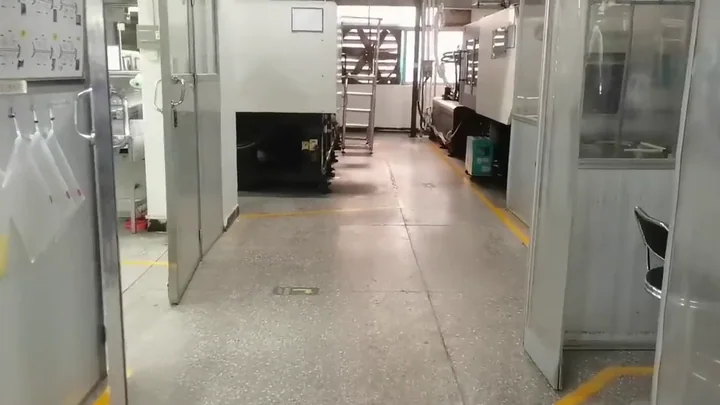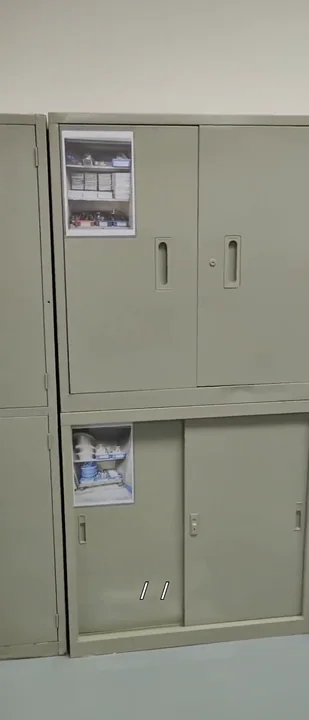
Prepare against the plan
Locate the mold using the production board and rack system. Prepare retrieval tools, check cooling connections and inspect the mold before installation.
MANUFACTURING / XINYINHAI FACTORY · CHINA
Xinyinhai’s in-house toolroom connects mold machining, trials and repair with controlled injection molding.
Development, tooling and molding teams work through a documented review process. Mold condition, material preparation, verified settings and inspection connect the trial sample to repeat production.
View factory evidence Original photographs and summaries of the factory’s working records.
01 / CAPABILITY FACTS
Xinyinhai’s in-house toolroom supports the molding operation. Factory records identify milling and grinding equipment, a 24-machine molding baseline and defined production controls.
Count in the supplied equipment inventory, corroborated by the workshop improvement report.
Range listed in the equipment inventory. T denotes the source’s machine tonnage designation.
Samples and inspection instructions connect setup to the production decision.
Milling and grinding support mold machining, adjustment and repair alongside molding.
Equipment figures describe the supplied inventory, corroborated by the improvement report that discusses operations through 2025. Confirm current machine availability and project fit during quotation. Review the equipment and its role.
02 / TOOLING TO MOLDING
Preparation leads to a verified first article, then controlled production and inspection. Each step supplies the information or condition needed by the next.
Development, tooling and molding teams review the mold design together; trial feedback informs modifications.
Documented inDevelopment and mold-trial workflow
Stage the mold, cooling connections and required handling tools.
Documented inStaging improvement record
Identify, dry and mix material to the applicable instructions.
Documented inMaterial and mixing standards
Check setup, auxiliary equipment and documented process settings.
Documented inSetup and handover instructions
Confirm the molded sample and communicate product-specific inspection points.
Documented inFirst-article controls
Use the reference sample, work instructions and operator self-checks.
Documented inProduction and training standards
Check appearance and critical features; isolate abnormal output for review.
Documented inMolding quality instructions
Carry confirmed settings, inspection feedback and shift handovers into repeat runs.
Documented inProduction flow and handover standards
Sequence summarized from the development and production flows, mold-installation training and standardized quality instructions. Inspection and corrective action continue throughout production. See how trial feedback returns to tooling.
03 / IN-HOUSE TOOLING · XINYINHAI’S MOLD ROOM
Xinyinhai’s in-house toolroom supports mold machining, maintenance and repair alongside injection molding. Milling and grinding provide machining support; joint reviews connect mold design and trial feedback to the next modification.
The mold-making scope and any external operations for a new tool are agreed during project review.
See the equipment recordMolding feedback returns to the development and tooling review.
This keeps the sample result, tooling decision and next molding trial in the same documented sequence, with direct input from the teams doing the work.
Locate the mold using the production board and rack system. Prepare retrieval tools, check cooling connections and inspect the mold before installation.
Confirm mold size and machine fit, nozzle alignment, clamping, cooling connections and ejection. Check mold-protection settings during installation.
The improvement record includes gate changes that reduced manual runner finishing in a specific application, plus successive take-out fixture improvements.
Record basis: equipment inventory; joint mold-design and trial-review workflow; production repair and maintenance flow; mold-installation training. The development record connects trial evaluation and molding feedback to mold modification and a further trial.
04 / EQUIPMENT & SUPPORT
The inventory lists injection molding machines together with drying, mixing, temperature control, part handling and runner-recovery equipment.
| Equipment | Documented provision | Role in the process |
|---|---|---|
| Injection molding machines | 24 listed; 98–380 T nominal classes | Machine selection starts with the mold and component requirements. |
| Material preparation | Drying hoppers and horizontal / vertical mixers | Prepare identified material before feeding the molding process. |
| Mold temperature control | Water-temperature control units | Support the specified mold-temperature setup. |
| Part handling | Take-out robots and conveyors | Support removal and transfer of molded parts. |
| Runner recovery | Machine-side granulation and recovery; separate granulation equipment | Reduce handling where the applicable material and product requirements permit reuse. |
| In-house tooling support | A grinder and a milling machine listed in the inventory | Support mold machining, adjustment and repair. Review the required operations for each new tool. |
Factory evidence: equipment inventory, equipment-management references and machine-parameter workbook. Tonnage is a nominal clamping-force class, not part weight, injection pressure or a guaranteed component-size limit. Machine fit also requires the mold dimensions, opening and ejection requirements to be checked.
05 / MATERIAL & PROCESS CONTROL
Defined preparation instructions connect identified material, drying and mixing to machine setup, mold temperature and the production parameter sheet.
Confirm the production material against the job information. After mixing, bag and label it so the prepared material remains identifiable.
Documented control at XinyinhaiMixing standard: cleaning, staged mixing, bagging and labeling.
Use the material-specific drying temperature and duration, with a defined mixing sequence. Check the hopper, air path and feed opening during material change preparation.
Documented control at XinyinhaiMaterial parameter table and screw-cleaning training.
Verify mold-to-machine fit, cooling connections, ejection and mold protection. Confirm the selected process settings before producing the first article.
Documented control at XinyinhaiMold-installation instructions and setup checks.
Check the production parameter sheet and auxiliary equipment. Technicians hand over abnormalities, improvements and parameter changes to the next shift.
Documented control at XinyinhaiStandardized technician handover and checkpoint list.
06 / STANDARDIZED INJECTION MOLDING
Operators and technicians check the current product, process condition and workstation, then hand over changes and open issues to the next shift.
Factory evidence: operator and technician handover instructions; production checkpoints; role-specific training.
Confirm machine, mold and material preparation, auxiliary equipment, the parameter sheet and first-article processing sample.
Follow the processing sample and packaging instructions. Check appearance, critical structures, tools and workstation order, with focused checks on known problems.
Report abnormalities, identify affected parts and involve the technician and quality inspector. Carry parameter changes and follow-up actions into shift handover.
Repeat product-specific training and follow up the operator’s working method and understanding of the quality requirements.
07 / FACTORY EVIDENCE
Original photographs show mold care and production support. Equipment lists, development reviews and standardized work instructions explain how those activities connect.
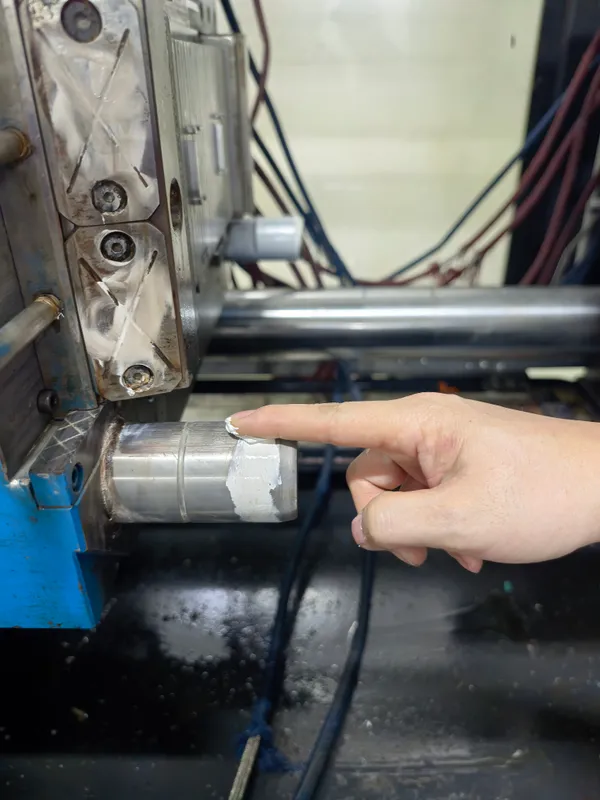
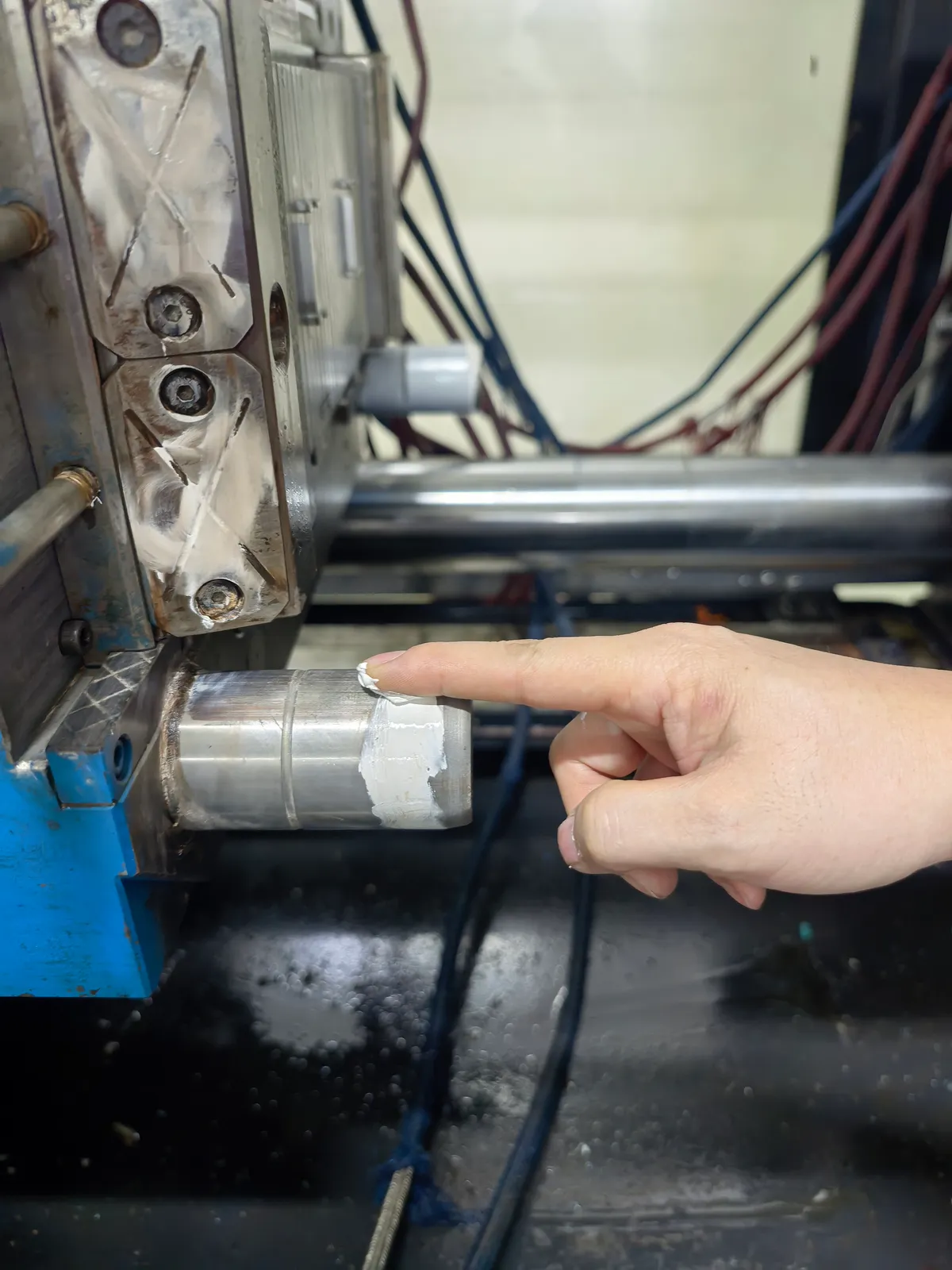
The production-management instructions include cleaning and lubrication of moving parts. This source photograph shows lubricant applied to a guide post.
View mold-maintenance photo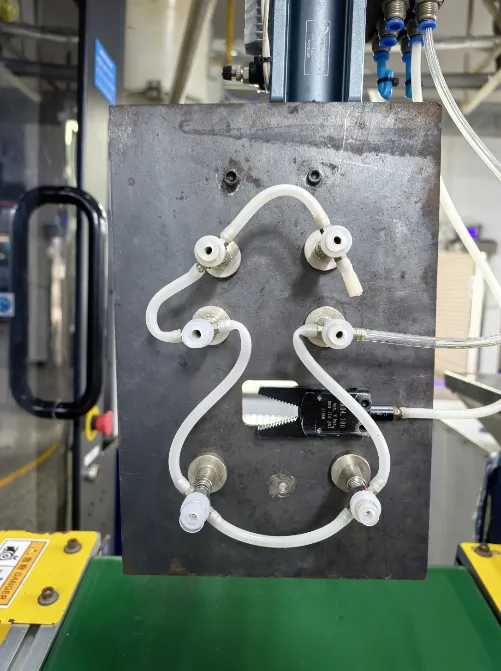
The workshop report shows this steel-plate take-out fixture with magnetic fittings as the final step in its fixture-installation improvement example.
View the take-out fixture photo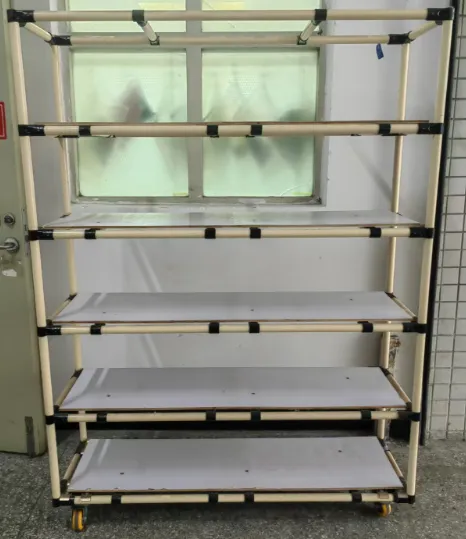
The factory’s standardized work instructions illustrate this wheeled rack as a material-handling reference.
Review the shift and workstation checksJoint reviews include molding feedback and lead to the next trial. The record identifies development, tooling and injection molding as participants.
See the tooling feedback loopThe production flow calls out mold-fault and flash repairs. Installation training requires relevant damage to be repaired before mounting.
Review mold care and return checksOperator checks and patrol inspection feed abnormalities to technicians and quality personnel for action and verification.
See the quality control pointsThe diagrams and record summaries are English explanations of internal factory documents. Original photographs are identified separately; internal records are not public downloads.
15 → 3 minutes per mold
The record describes production-board information, organized retrieval tools and sliding racks. The time is for staging / retrieval, not complete mold changeover or first-article approval.
Workshop improvement record, slides 14–15.
30 → 10 minutes
The documented sequence moves from assembled aluminum sections through a dedicated plate to a steel plate with magnetic fittings, reducing installation work in that example.
Workshop improvement record, slides 16–17.
These are historical before-and-after examples from the factory’s improvement report. They are not universal changeover times, independently audited performance figures or delivery promises.
The same report documents machine layout, runner recovery, workstation organization, production boards and training (slides 11–12, 18 and 20–26).
08 / QUALITY INSIDE MOLDING
First articles, self-checks and patrol inspection connect output to the required sample and instructions. Abnormal parts are isolated while the team investigates and verifies the response.
Confirm appearance, assembly fit and the product’s inspection priorities before routine production.
Work to the processing sample and instructions; report defects and abnormal operating conditions.
Inspect appearance, structure, working methods and known problem areas during the run.
Identify nonconforming parts and place them in the designated area awaiting disposition.
The technician investigates and adjusts the process, escalating unresolved issues to the production leader.
Quality personnel confirm the result; affected output requires a quality decision or the specified full inspection.
Factory evidence: standardized molding quality instructions, quality-focused training and the factory’s production flow. Inspection priorities follow the component and its applicable requirements.
09 / PREVENTIVE MOLD MAINTENANCE
The mold-removal and rust-prevention instructions cover cleaning, protective treatment, inspection and storage, followed by checks before the next run.
Factory evidence: mold rust-prevention guidance dated 12 November 2025, supported by mold-removal and installation training.
Check the parting surface and remove contamination. Pay attention to vents, ribs, inserts and slide areas.
Follow the temperature-dependent treatment instructions and check protective coverage before removing the mold.
Clear residual cooling water, protect the treated surfaces and return the mold to its assigned position.
Recheck connections, alignment, ejection and mold protection during installation, then confirm the first article.
10 / PEOPLE & TRAINING
Process consistency depends on trained people, not equipment alone. Training and handover instructions assign work to operators, technicians, material handlers, quality inspectors and production leaders.
Factory evidence: role-training workbook, standardized handover instructions and workshop training records.
Browse inspector-training defect referencesACTIVITIES & COMMUNITY
Explore workshop records and the working areas behind tooling and production.
A walkthrough records the injection department around the 2025 Spring Festival break.
A workshop walkthrough records tool storage and supporting equipment.
11 / PROCUREMENT QUESTIONS
For teams evaluating an injection molding manufacturer in China, the useful questions connect documented equipment to tooling scope, materials, quality and repeat production.
Yes. Xinyinhai’s in-house toolroom supports mold machining, maintenance and repair alongside injection molding. The equipment inventory lists milling and grinding machines. Development, tooling and molding teams review mold design and trial feedback together. The manufacturing scope and any external operations for a new tool are confirmed during project review.
The development workflow connects trial samples, testing and evaluation with a joint review and injection-molding feedback. Mold modifications feed into the next trial and review. This gives tooling and molding teams a shared sequence for resolving issues before the next production stage.
The supplied inventory lists 24 injection molding machines across 98–380 T nominal clamping-force classes. The workshop improvement report corroborates the count. Confirm the available machine and mold fit for your project; this is a documented equipment baseline, not a live capacity booking.
The internal material table defines material-specific drying temperatures and times alongside molding and mold-temperature settings. Preparation training also includes checking the drying hopper, air path and feed opening. The applicable material grade and job instructions govern the settings.
The instructions cover cleaning the parting surface, protecting vents, inserts and slides, checking rust-prevention coverage and clearing residual cooling water. The mold is returned to its assigned storage position and checked again during the next installation.
First-article confirmation, operator self-checks and patrol inspection connect production to the reference sample and work instructions. Abnormal parts are identified and isolated. Technicians and quality personnel review corrective action and the disposition of affected output.
The documented controls connect the production parameter sheet, first-article sample, operating instructions and in-process checks. Technicians communicate parameter changes and abnormalities at shift handover, while product-specific training is repeated after a mold change.
The factory overview identifies OEM and ODM work in plastic, electronic and toy products. These molding controls support evaluation of an OEM injection molding or ODM injection molding project. Product geometry, material, appearance, assembly requirements and destination-market requirements still need project review.
The improvement report documents machine-side granulation and controlled runner recovery. The applicable material and product requirements must determine whether recovered material is suitable. The record does not establish a universal recycled-content specification.
12 / YOUR NEXT PROJECT
Share the component requirements, available mold information and production expectations so tooling and injection molding can be reviewed together.
Use the inquiry form to prepare your requirements, or share the completed brief through your existing LEANODM contact. The download prepares your inquiry; it does not send it.